


Page 15 - ebook
P. 15
High-metastatic Potential MicroRNAs in Human Colorectal Cancer
Hagyeong Lee 1,2 , , Eun Hwangbo , Huiwon Do , Yu Rim Lee , Se Young Jang , Min Kyu Kang , Jung Gil Park ,
4
4
3
1,2
5
5
4
Hye Won Lee , Won Young Tak , Soo Young Park , Keun Hur 1,2
4
6
1. Department of Biochemistry and Cell Biology, School of Medicine, Kyungpook National University, Daegu, South Korea
2. BK21 Plus KNU Biomedical Convergence Program, Department of Biomedical Science, Kyungpook National University, Daegu, Korea
3. Department of Biomedical Convergence Science and Technology, School of Convergence, Kyungpook National University, Daegu, Korea
4. Department of Internal Medicine, School of Medicine, Kyungpook National University, Kyungpook National University Hospital, Daegu, South Korea
5. Department of Internal Medicine, College of Medicine, Yeungnam University, Daegu, South Korea
6. Department of Pathology, Keimyung University School of Medicine, Daegu, South Korea
Background and Aim Results
Colorectal Cancer (CRC) is easy to metastasize I. SW480 (CRC cell line) was treated with TGF-β1 to induce EMT.
to distant organ, and this significance is an Metastatic-potential miRNAs in EMT-induced SW480 cells and exosomes
major cause of high mortality rate. Cell morphology
MET down EMT UP MET up EMT DOWN
(Cell) (Exosome) (Cell) (Exosome)
Epithelial-mesenchymal transition (EMT) is
essential and initial to cancer metastasis,
whereas its reverse process, mesenchymal to
epithelial transition (MET), support the
development of premetastatic niche and
proliferation of metastasized cancer cells in
distant organs.
EMT related marker expression EMT UP MET down EMT DOWN MET up
(Cell) (Exosome) (Cell) (Exosome)
MicroRNAs (miRNAs) have known as upstream
regulater in cancer metastasis and EMT-related
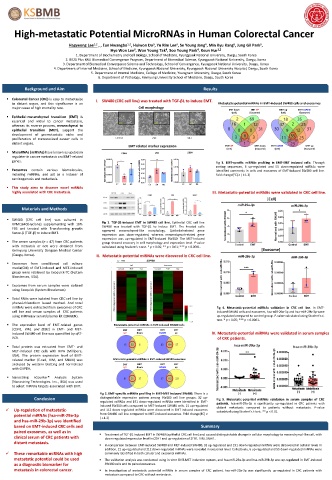
genes. Fig 3. EMT-specific miRNAs profiling in EMT-MET induced cells. Through
sorting sequences, 6 up-regulated and 55 down-regulated miRNAs were
Exosomes contain various biomolecules, identified commonly in cells and exosomes of EMT-induced SW480 cell line.
including miRNAs, and act as a inducer of Fold change(FC) ≥ |±1.2|
carcinogenesis and metastasis.
This study aims to discover novel miRNAs
highly associated with CRC metastasis. III. Metastatic-potential miRNAs were validated in CRC cell line.
[Cell]
Materials and Methods *
*
SW480 (CRC cell line) was cultured in
RPMI1640(Hyclone) supplementing with 10% Fig 1. TGF-β1-induced EMT in SW480 cell line. Epithelial CRC cell line
FBS and treated with Transforming growth SW480 was treated with TGF-β1 to induce EMT. The treated cells
gene
mesenchymal-like
Epithelial-related
morphology.
appeared
factor-β (TGF-β) to induce EMT. expression was down-regulated, whereas mesenchymal-related gene
expression was up-regulated in EMT-induced SW480. The MET-induced
The serum samples (n = 47) from CRC patients group showed recovery in cell morphology and expression level. P-value
with metastsis or not were obtained from calculated using Student’s t-test. * p < 0.05; ** p < 0.01; *** p < 0.0001.
Keimyung University Dongsan Medical Center [Exosome]
(Daegu, Korea). II. Metastatic-potential miRNAs were dicovered in CRC cell line.
Exosomes from conditioned cell culture
media(CM) of EMT-induced and MET-induced ***
group were retrieved by Exoquick-TC (System
Biosciences, USA).
Exosomes from serum samples were isolated
using Exoquick (System Biosciences)
Total RNAs were isolated from CRC cell line by
phenol-chloroform based method. And total
miRNAs were extracted from exosomes of CRC Fig 4. Metastatic-potential miRNAs validation in CRC cell line. In EMT-
cell line and serum samples of CRC patients induced SW480 cells and exosomes, hsa-miR-29a-3p and hsa-miR-29b-3p were
using miRNeasy serum/plasma kit (QIAGEN). up-regulated compared to control group. P-value calculated using Student’s t-
test. * p < 0.05; *** p < 0.0001.
The expression level of EMT-related genes Metastatic-potential miRNAs in EMT-induced SW480 cells
(CDH1, VIM, and ZEB1) in EMT- and MET- EMT MET EMT MET
induced SW480 cell line was quantified by qRT- UP down DOWN up IV. Metastatic-potential miRNAs were validated in serum samples
PCR. of CRC patients.
Total protein was extracted from EMT- and
MET-induced CRC cells with RIPA (Millipore,
USA). The protein expression level of EMT-
related marker (E-cad, VIM, and SNAI1) was Metastatic-potential miRNAs in EMT-induced SW480 exosomes
analyzed by western blotting and normalized EMT MET EMT MET
with GAPDH. UP down DOWN up
Nanostring nCounter® Analysis System
(Nanostring Technologies. Inc., USA) was used
to select miRNAs targets associated with EMT.
Fig 2. EMT-specific miRNAs profiling in EMT-MET induced SW480. There is a
Conclusion distinguishable expression pattern among SW480 cell line groups. 32 up- Fig 5. Metastatic-potential miRNAs validation in serum samples of CRC
regulated miRNAs and 191 down-regulated miRNAs were identified in EMT- patients. hsa-miR-29a-3p is significantly up-regulated in CRC patients with
induced SW480 cells compared to MET-induced SW480 cells. 21 up-regulated distant metastasis compared to patients without metastasis. P-value
Up-regulation of metastatic- and 112 down-regulated miRNAs were discovered in EMT-induced exosomes calculated using Student’s t-test. ** p < 0.01.
potential miRNAs (hsa-miR-29a-3p from SW480 cell line compared to MET-induced exosomes. Fold change(FC) ≥
|±1.2|
and hsa-miR-29b-3p) was identified
based on EMT-induced CRC cells and Summary
paired exosomes, as well as in
clinical serum of CRC patients with Treatment of TGF-β1 induced EMT in SW480 (epithelial CRC cell line) and caused distinguishable change in cellular morphology to mesenchymal-like cell, with
down-regulated expression level in CDH1 and up-regulation of ZEB1, VIM, SNAI1.
distant metastasis.
In comparison between EMT-induced SW480 and MET-induced SW480, 32 up-regulated and 191 down-regulated miRNAs were discovered in cellular level. In
addition, 21 up-regulated and 112 down-regulated miRNAs were revealed in exosomal level. Collectively, 6 up-regulated and 55 down-regulated miRNAs were
These remarkable miRNAs with high commonly identified in both cellular and exosomal miRNAs.
metastatic potential could be used The validation analysis was conducted using in vitro EMT-MET induction system, and hsa-miR-29a-3p and hsa-miR-29b-3p was up-regulated in EMT-induced
as a diagnostic biomarker for SW480 cells and its paired exosomes.
metastasis in colorectal cancer. In investigation of metastatic potential miRNAs in serum samples of CRC patient, hsa-miR-29a-3p was significantly up-regulated in CRC patients with
metastasis compared to CRC without metastasis.

