


Page 15 - L. Genetics and genomics
P. 15
In Silico Evaluation of Acetylation Mimics in the 27 Lysine Residues
of Human Tau Protein
Yong-Chan Kim, Byung-Hoon Jeong
Korea Zoonosis Research Institute, Jeonbuk National University, Iksan 54531, Republic of Korea
Department of Bioactive Material Sciences, Jeonbuk National University, Jeonju 54896, Republic of Korea
Abstract Introduction
Background: Various neurodegenerative diseases, including Several neurodegenerative diseases, including Alzheimer’s
Alzheimer’s disease (AD), are related to abnormal Disease (AD), Frontal Temporal Dementia (FTD), Parkinson’s
hyperphosphorylated microtubule-associated protein tau Disease (PD), Corticobasal Dege-neration (CBD), Argyrophilic
accumulation in brain lesions. Recent studies have focused on Grain Dementia (AGD), Progressive Supranuclear Palsy (PSP)
toxicity caused by another post-translational modification and Pick’s Disease (PiD), are characterized by the
(PTM), acetylation of the lysine (K) residues of tau protein. accumulation of an irregular intracellular filamentous protein
Because there are numerous acetylation sites, several studies tau in the somatodendritic region of neurons, known as
have introduced mimics of tau acetylation using amino acid tauopathies. Abnormal tau protein aggregation is composed of
substitutions from lysine to glutamine (Q). However, human tau hyper-phosphorylated microtubule-associated protein tau and
protein contains over 20 acetylation sites; thus, investigation of induces neuronal cell death.
the effects of an acetylated tau is difficult. In a recent study, another Post-Translational Modification
Objective: Here, the authors in silico evaluated acetylation Tau Paired Helical Filament (PTM) of tau protein, acetylation at lysine (K) residues,
effects using SIFT, PolyPhen-2 and PROVEAN which can (picture from PDB: 5O3L) including 174K, 274K, 280K and 281K, has been associated
estimate the effects of amino acid substitutions based on the with tauopathies. Posttranslational acetylated modification of
sequence homology or protein structure in tau isoforms. In lysine can also trigger aggregation of tau proteins.
addition, they also investigated 27 acetylation effects on the Because tau protein has 27 lysine residues, which are prone
amyloid formation of tau proteins using Waltz. to acetylation, the investigation of acetylated tau is difficult. For
Results: 15 acetylation mimics were estimated to be the most this reason, some studies have introduced mimics of
detrimental, which indicates that there may be novel acetylated forms of tau proteins to investigate PTMs of tau
pathogenic acetylation sites in the human tau protein. proteins. Acetylation mimics have amino acid substitutions
Interestingly, the deleterious effect of acetylation mimics was from lysine (K) to glutamine (Q). Some studies have used
different according to the type of isoforms. Furthermore, all these PTM mimics, but the acetylation effect has been
acetylation mimics were predicted to be a region of amyloid investigated in only a few lysine residues.
formation at the codons 274-279 of human tau protein. Notably, In the present study, we selected 27 lysine residues and
acetylation mimic of codon 311 (K311Q) induced the formation changed lysine residues to glutamine to mimic acetylation. The
of an additional amyloid region located on codons 306-311 of effects of amino acid substitution to the normal tau protein
the human tau protein. function were measured by SIFT, PolyPhen-2 and PROVEAN.
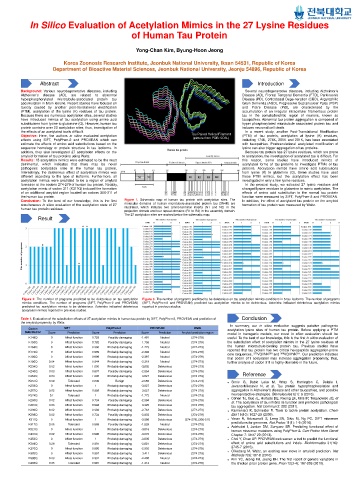
Conclusion: To the best of our knowledge, this is the first Figure 1. Schematic map of human tau protein with acetylation sites. The In addition, the effect of acetylated tau protein on the amyloid
simultaneous in silico evaluation of the acetylation state of 27 molecular domains of human microtubule-associated protein tau (2N4R) are formation of tau protein was measured by Waltz.
human tau protein residues. illustrated, which includes two amino-terminal inserts (N1 and N2) in the
projection domain and four repeat domains (R1 to R4) in the assembly domain.
The 27 acetylation sites are marked below the schematic map.
Result
1N4R 0 1 2 3 0N4R 0 1 2 3 2N3R 0 1 2 3 1N3R 0 1 2 3 0N3R 0 1 2 3
Figure 2. The number of programs predicted to be deleterious on tau acetylation Figure 3. The number of programs predicted to be deleterious on tau acetylation mimics conditions in 5 tau isoforms. The number of programs
mimics conditions. The number of programs (SIFT, PolyPhen-2 and PROVEAN) (SIFT, PolyPhen-2 and PROVEAN) predicted tau acetylation mimics to be deleterious. Asterisks indicated deleterious acetylation mimics
predicted tau acetylation mimics to be deleterious. Asterisks indicated deleterious reported in previous studies.
acetylation mimics reported in previous studies.
Table 1. Evaluation of the substitution effects of 27 acetylation mimics in human tau protein by SIFT, PolyPhen-2, PROVEAN and prediction of Conclusion
the amyloid propensity by Waltz.
In summary, our in silico evaluation suggests putative pathogenic
Codon SIFT PolyPhen-2 PROVEAN Waltz acetylation lysine sites of human tau protein. Before applying a PTM
Substitution Score Prediction Score Prediction Score Prediction Amyloid prediction region model in transgenic models, our novel in silico evaluation should be
K148Q 0 Affect function 0.728 Possibly damaging -1.491 Neutral [274-279] useful. To the best of our knowledge, this is the first in silico evaluation of
K150Q 0 Affect function 0.782 Possibly damaging -1.756 Neutral [274-279] the substitution effect of acetylation mimics in the 27 lysine residues of
K163Q 0 Affect function 0.990 Probably damaging -1.773 Neutral [274-279] the human microtubule-binding protein tau. Previous studies have
reported that tau protein has two critical hexapeptide aggregation-prone
K174Q 0 Affect function 0.999 Probably damaging -2.336 Neutral [274-279]
core sequences, 275 VQIINK 280 and 306 VQIVYK 311 . Our prediction indicates
K180Q 0 Affect function 0.999 Probably damaging -2.397 Neutral [274-279]
that codon 311 acetylation may increase aggregation propensity, thus,
K190Q 0.04 Affect function 0.944 Probably damaging -2.318 Neutral [274-279] further analysis of codon 311 is highly desirable in the future.
K234Q 0.02 Affect function 1.000 Probably damaging -3.802 Deleterious [274-279]
K240Q 0.03 Affect function 0.607 Possibly damaging -2.854 Deleterious [274-279]
K254Q 0.03 Affect function 1.000 Probably damaging -3.827 Deleterious [274-279] Reference
K257Q 0.09 Tolerated 0.096 Benign -2.568 Deleterious [274-279] ◆ Simic G, Babic Leko M, Wray S, Harrington C, Delalle I,
K259Q 0 Affect function 1 Probably damaging -3.827 Deleterious [274-279] JovanovMilosevic N, et al. Tau protein hyperphosphorylation and
K267Q 0.02 Affect function 0.998 Probably damaging -3.627 Deleterious [274-279] aggregation in Alzheimer's disease and other tauopathies, and possible
neuroprotective strategies. Biomolecules 6(1): 6 (2016).
K274Q 0.1 Tolerated 1 Probably damaging -1.772 Neutral [274-279]
◆ Cohen TJ, Guo JL, Hurtado DE, Kwong LK, Mills IP, Trojanowski JQ, et
K280Q 0.02 Affect function 0.734 Possibly damaging -2.594 Deleterious [274-279]
al. The acetylation of tau inhibits its function and promotes pathological
K281Q 0.03 Affect function 0.998 Probably damaging -3.325 Deleterious [274-279] tau aggregation. Nat Commun 2: 252 (2011).
K290Q 0.02 Affect function 0.986 Probably damaging -2.764 Deleterious [274-279] ◆ Kamieniarz K, Schneider R. Tools to tackle protein acetylation. Chem
K298Q 0.02 Affect function 0.734 Possibly damaging -2.903 Deleterious [274-279] Biol 16(10): 1027-29 (2009).
K311Q 0 Affect function 1 Probably damaging -3.596 Deleterious [274-279], [306-311] ◆ Vaser R, Adusumalli S, Leng SN, Sikic M, Ng PC. SIFT missense
predictions for genomes. Nat Protoc 11(1): 1-9 (2016).
K317Q 0.06 Tolerated 0.589 Possibly damaging -1.528 Neutral [274-279]
◆ Adzhubei I, Jordan DM, Sunyaev SR. Predicting functional effect of
K321Q 0 Affect function 1 Probably damaging -3.816 Deleterious [274-279]
human missense mutations using PolyPhen-2. Curr Protoc Hum Genet
K331Q 0.02 Affect function 0.996 Probably damaging -3.072 Deleterious [274-279] Chapter 7: Unit7 20 (2013).
K353Q 0 Affect function 1 Probably damaging -3.835 Deleterious [274-279] ◆ Choi Y, Chan AP. PROVEAN web server: a tool to predict the functional
K369Q 0.29 Tolerated 0.991 Probably damaging -2.621 Deleterious [274-279] effect of amino acid substitutions and indels. Bioinformatics 31(16):
2745-7 (2015).
K370Q 0 Affect function 0.995 Probably damaging -2.902 Deleterious [274-279]
◆ Oliveberg M. Waltz, an exciting new move in amyloid prediction. Nat
K383Q 0 Affect function 0.997 Probably damaging -3.411 Deleterious [274-279]
Methods 7(3):187-8 (2010).
K385Q 0.03 Affect function 0.991 Probably damaging -2.400 Neutral [274-279] ◆ Kim YC, Jeong MJ, Jeong BH. The first report of genetic variations in
K395Q 0.25 Tolerated 0.991 Probably damaging -1.314 Neutral [274-279] the chicken prion protein gene. Prion 12(3-4): 197-203 (2018).

