Page 13 - L. Genetics and genomics
P. 13
Strong association of regulatory single nucleotide polymorphisms (SNPs) of the


                                                                     IFITM3 gene with influenza H1N1 2009 pandemic virus infection


                                                                                                                                                                     Yong-Chan Kim, Byung-Hoon Jeong


                                                                                        Korea Zoonosis Research Institute, Jeonbuk National University, Iksan 570-390, Republic of Korea


                                               BK PLUS Program in Department of Bioactive Material Sciences, Jeonbuk National University, Jeonju 561-756, Republic of Korea


                       ABSTRACT


                       IFITM3 gene is an important host immunological effector against viral invasion for


                       various viruses, including influenza A viruses. In the present study, the purpose was


                       to conduct fine mapping of the IFITM3 gene and compare the genetic differences


                       of the IFITM3 gene between those of healthy Koreans and H1N1 2009 pandemic


                       influenza-infected patients. Significant differences between healthy controls and


                       H1N1 pandemic influenza 2009 affected patients were observed in the genotype


                       frequencies of 5 regulatory SNPs, c.-204G>T (P = 0.039), c.-188T>C (P < 0.0001),


                       c.-181T>C (P = 0.0003), c.-178A>C (P = 0.0002) and c.-175T>C (P = 0.0002), and 1


                       intronic SNP, c.249+450T>C (P = 0.007), in the Korean population. However, the


                       IFITM3 c.-23G>A (rs34481144) polymorphism was not found in the Korean


                       population. In addition, we found significantly different haplotype distributions of


                       the IFITM3 gene between those of H1N1 influenza 2009 pandemic patients and


                       healthy controls. Furthermore, we identified that regulatory SNP, c.-188T>C can


                       modulate promoter binding ability of TFII-I transcription factor. Two haplotypes of


                       promoter region with different distribution between H1N1 influenza 2009


                       pandemic patients and healthy controls showed significantly different promoter


                       activity.


                        INTRODUCTION                                                                                                                                   RESULTS                                                                                                                                              CONCLUSIONS


                       The interferon-induced transmembrane protein 3 gene                                                                                                                                                                                                                                                   In conclusion, we identified a total of 6 novel


                       (IFITM3) is classified as a member of the small interferon-                                                                                                                                                                                                                                           H1N1 influenza 2009 pandemic related SNPs, 5


                       stimulated genes (ISGs) and plays a paramount role in                                                                                                                                                                                                                                                 regulatory SNPs, c.-204G>T, c.-188T>C, c.-181T>C,


                       defense against enveloped viruses, including influenza A


                       viruses. A previous study reported that the rs12252 SNP,                                                                                                                                                                                                                                              c.-178A>C and c.-175T>C, and 1 intronic SNP,

                       which is located in the open reading frame (ORF) of the                                                                                                                                                                                                                                               c.249+450T>C,                          in        the          Korean               population.                    In


                       IFITM3 gene, impacts the splicing procedure of protein                                                                                                                                                                                                                                                addition,                   we            found                significantly                       different


                       production, which makes a truncated form of the IFITM3                                                                                                                                                                                                                                                haplotype                   distributions                      of        the          IFITM3               gene


                       protein and lowers its antiviral capacity. Thus, several


                       studies have focused on identifying correlations between                                                                                                                                                                                                                                              between those of H1N1 influenza 2009 pandemic

                       the genotype of the rs12252 SNP and susceptibility to 2009                                                                                                                                                                                                                                            patients and healthy controls. Furthermore, we


                       pandemic influenza virus infection. However, some studies                                                                                                                                                                                                                                             found               that           regulatory                    SNP,            c.-188T>C                     can


                       failed to verify the correlation, and two studies did not find                                                                                                                                                                                                                                        modulate the binding ability of TFII-I transcription


                       the rs12252 SNP-induced Δ21 IFITM3 protein splicing                                                                                                                                                                                                                                                   factor and identified that haplotypes of promoter

                       isoform in vitro and in vivo.


                       In a recent study, Allen et al. identified that the rs34481144                                                                                                                                                                                                                                        region,               which               showed                  different                 distribution


                       SNP located in the 5’ untranslated region (UTR) of the IFITM3                                                                                                                                                                                                                                         between                   2009              pandemic                     influenza                  infected


                       gene alters the binding ability of the vital transcription factor                                                                                                                                                                                                                                     patients and healthy controls, affect transcriptional


                       CTCF. Due to the rs34481144 SNP genotype being located on                                                                                                                                                                                                                                             activity of IFITM3 gene. To the best of our


                       a CpG, the IFITM3 promoter activity and expression level of

                       the IFITM3 gene are changed. In addition, the rs34481144                                                                                                                                                                                                                                              knowledge, this study is the first genetic report of


                       SNP genotype affects the transcriptional regulation of                                                                                                                                                                                                                                                novel H1N1 influenza 2009 pandemic related SNPs.


                       IFITM3-neighboring genes and showed a potent association


                       with the clinical results of the H1N1 influenza 2009 pandemic

                       in three human cohorts. Another study in Portuguese and                                                                                                                                                                                                                                                REFERENCES


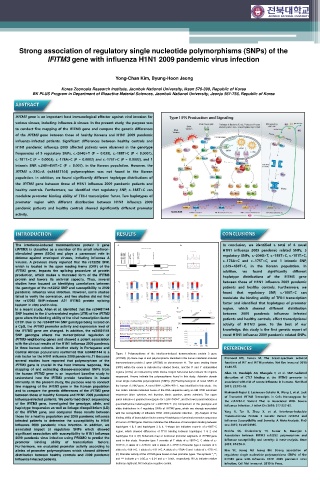
                       Central African populations reaffirmed that rs34481144 is a                                                                                   Figure 1 Polymorphisms of the interferon-induced transmembrane protein 3 gene


                       risk factor for the H1N1 influenza 2009 pandemic.11 Because                                                                                   (IFITM3 (A) Gene map of and polymorphisms identified in the human interferon-induced                                                                      Diamond MS, Farzan M. The broad-spectrum antiviral
                                                                                                                                                                                  ).
                       several studies have reported that polymorphism of the                                                                                        transmembrane protein 3 gene (IFITM3 on chromosome 11. The open reading frame                                                                             functions of IFIT and IFITM proteins. Nat Rev Immunol 2013;
                                                                                                                                                                                                                                       )
                       IFITM3 gene is crucial in the host immune response, fine                                                                                                                                                                                                                                                13:46-57.


                       mapping of and extracting disease-associated SNPs from                                                                                        (ORF) within the exons is indicated by shaded blocks, and the 5’ and 3’ untranslated

                       the human IFITM3 gene is an important baseline study to                                                                                       regions (UTRs) are indicated by white blocks. Edged horizontal bars indicate the regions                                                                  Allen EK, Randolph AG, Bhangale T, et al. SNP-mediated


                       understand how the IFITM3 protein functions in innate                                                                                         sequenced. Arrows indicate the polymorphisms found in this study. Asterisks denote                                                                        disruption of CTCF binding at the IFITM3 promoter is


                       immunity. In the present study, the purpose was to conduct                                                                                    novel single nucleotide polymorphisms (SNPs). (B) Electropherogram of novel SNPs of                                                                       associated with risk of severe influenza in humans. Nat Med


                       fine mapping of the IFITM3 gene in the Korean population                                                                                      the human IFITM3 gene. A novel SNP, c.249+74G>T, was identified in this study. The                                                                        2017; 23:975-83.

                       and to compare the genetic differences of the IFITM3 gene                                                                                     four colors indicate individual bases of the DNA sequence using an ABI 3730 automatic                                                                     Makvandi-Nejad S, Laurenson-Schafer H, Wang L, et al. Lack


                       between those of healthy Koreans and H1N1 2009 pandemic                                                                                       sequencer (blue: cytosine, red: thymine, black: guanine, green: adenine). The upper                                                                       of Truncated IFITM3 Transcripts in Cells Homozygous for


                       influenza-infected patients. We performed direct sequencing                                                                                   panel indicates a guanine homozygote for c.249+74G>T, and the lower panel indicates a                                                                     the rs12252-C Variant That is Associated With Severe


                       of the IFITM3 gene, investigated the genotype, allele, and                                                                                    guanine/thymine heterozygote for c.249+74G>T. (C) Comparison of the genotype and                                                                          Influenza Infection. J Infect Dis 2018; 217:257-62.


                       haplotype frequencies as well as linkage disequilibrium (LD)                                                                                  allele distributions in 4 regulatory SNPs of IFITM3 gene, which are strongly associated

                       of the IFITM3 gene, and compared these results between                                                                                        with the susceptibility of influenza H1N1 2009 pandemic infection. (D) Analysis of the                                                                    Yang          X,      Tan       B,      Zhou          X,      et      al.     Interferon-Inducible


                       those for a healthy population and 2009 pandemic influenza                                                                                    binding ability of transcription factor among 4 haplotypes of proximal promoter sequences                                                                 Transmembrane Protein 3 Genetic Variant rs12252 and


                       infected patients to determine the susceptibility to H1N1                                                                                     of human IFITM3 gene. Red box indicates the difference of transcription binding between                                                                   Influenza Susceptibility and Severity: A Meta-Analysis. PloS


                       influenza 2009 pandemic virus infection. In addition, we                                                                                      haplotypes 1 & 2 and haplotypes 3 & 4. Y-shape bar indicates zoom-in of c-188T>C                                                                          one 2015; 10:e0124985.


                       annotated impact of                                    regulatory SNPs which showed                                                           region, which showed differences of TFII-I binding between haplotypes 1 & 2 and                                                                           Prabhu             SS,       Chakraborty                 TT,       Kumar            N,       Banerjee             I.

                       significant association with susceptibility to H1N1 influenza                                                                                                                                                                                                                                           Association between IFITM3 rs12252 polymorphism and


                       2009 pandemic virus infection using PROMO to predict the                                                                                      haplotypes 3 & 4. (E) Schematic map of functional promoter segments of IFITM3 gene                                                                        influenza susceptibility and severity: A meta-analysis. Gene


                       promoter                   binding                ability              of         transcription                      factors.                 used in this study. Promoter type 1 consists of T allele of c.-188T>C, C allele of c.-                                                                    2018; 674:70-9.


                       Furthermore, we evaluated promoter activity according to                                                                                      181T>C, C allele of c.-178A>C and C allele of c.-175T>C Promoter type 2 consists of C


                       alleles of promoter polymorphisms which showed different                                                                                      allele of c.-188T>C, T allele of c.-181T>C, A allele of c.-178A>C and T allele of c.-175T>C.                                                              Kim YC, Jeong MJ, Jeong BH. Strong association of

                       distribution between healthy controls and 2009 pandemic                                                                                       (F) Promoter activity of the IFITM3 gene based on two promoter types. The symbols *, **,                                                                  regulatory single nucleotide polymorphisms (SNPs) of the


                       influenza infected patients.                                                                                                                  and *** indicate p < 0.05, p < 0.01 and p < 0.001, respectively. RLUs indicate relative                                                                   IFITM3 gene with influenza H1N1 2009 pandemic virus


                                                                                                                                                                     luciferase light unit. NC indicates negative control.                                                                                                     infection. Cell Mol Immunol. 2019 In Press.
   8   9   10   11   12   13   14   15   16   17   18