


Page 23 - I. Chemical biology and drug discovery
P. 23
Identification of inhibitors of Bcl-2 family protein-protein interaction(PPI) by
combining the BRET screening platform with virtual screening
I-Seul Park , Haeng Ran Seo , Kideok Kim , Honggun Lee , David Shum , Inhee Choi *, and Jiho Kim *
1
1
1
2
3
1
1
Screening Discovery Platform , Cancer Biology and Medicinal Chemistry of Institut Pasteur Korea
1
3
2
16, Daewangpangyo-ro 712 beon-gil, Bundang-gu, Seongnam-si, Gyeonggi-do, Korea
BACKGROUND AIM
Bcl-2 family proteins play key roles in tumor initiation, progression, We aim to find the novel compounds that inhibit the interactions
and resistance to therapy. Therefore, the protein-protein interactions between Bax/Bak and Bcl-xL by combining the
(PPIs) between the pro-survival proteins B-cell lymphoma (Bcl)-2, Nanoluciferase(Nluc)/YFP-based bioluminescence resonance
and Bcl-xL and the pro-apoptotic proteins Bax, and Bak could be energy transfer (BRET) assay with structure based virtual
attractive therapeutic targets for anti-cancer drug discovery. screening
METHODS
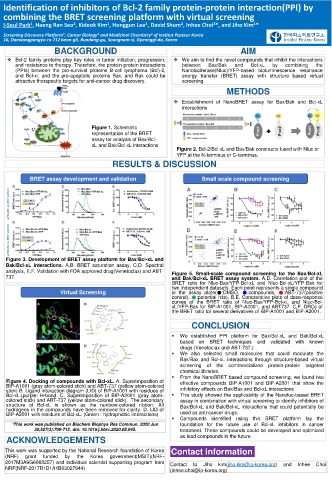
Establishment of NanoBRET assay for Bax/Bak and Bcl-xL
interactions
Figure 1. Schematic
representation of the BRET
assay for analysis of Bax/Bcl-
xL and Bak/Bcl-xL interactions
Figure 2. Bcl-2/Bcl-xL and Bax/Bak constructs fused with Nluc or
YFP at the N-terminus or C-terminus.
RESULTS & DISCUSSION
BRET assay development and validation Small scale compound screening
Figure 3. Development of BRET assay platform for Bax/Bcl-xL and
Bak/Bcl-xL interactions. A,B. BRET saturation assay, C,D. Spectral
analysis, E,F. Validation with FDA approved drug(Venetoclax) and ABT- Figure 5. Small-scale compound screening for the Bax/Bcl-xL
737. and Bak/Bcl-xL BRET assay system. A,D. Correlation plot of the
BRET ratio for Nluc-Bax/YFP-Bcl-xL and Nluc-Bcl-xL/YFP-Bak for
two independent datasets. Each point represents a single compound
Virtual Screening in the assay plate(●:DMSO, ●:compounds, ●:ABT-737(positive
control), ●:potential hits). B,E. Comparative plots of dose-response
curves of the BRET ratio of Nluc-Bax/YFP-Bcl-xL and Nluc-Bcl-
xL/YFP-Bak for BIP-A1001, BIP-A2001, and ABT737. C,F. DRCs of
the BRET ratio for several derivatives of BIP-A1001 and BIP-A2001.
CONCLUSION
We established PPI platform for Bax/Bcl-xL and Bak/Bcl-xL
based on BRET techniques and validated with known
drugs.(Venetoclax and ABT-737.)
We also selected small molecules that could modulate the
Bak/Bax and Bcl-xL interactions through structure-based virtual
screening of the commercialized protein-protein targeted
chemical libraries.
From the NanoBRET based compound screening, we found two
Figure 4. Docking of compounds with Bcl-xL. A. Superimposition of effective compounds BIP-A1001 and BIP-A2001 that show the
BIP-A1001 (gray atom-colored stick) and ABT-737 (yellow atom-colored
stick) B. Ligand interaction diagram (LID) of BIP-A1001 with residues of inhibitory effects on Bak/Bax and Bcl-xL interactions
Bcl-xL.(purple: H-bond. C. Superimposition of BIP-A2001 (gray atom- This study showed the applicability of the Nanoluc-based BRET
colored stick) and ABT-737 (yellow atom-colored stick). The secondary assay in combination with virtual screening to identify inhibitors of
structure of Bcl-xL is shown as the rainbow-colored ribbon. All Bax/Bcl-xL and Bak/Bcl-xL interactions that could potentially be
hydrogens in the compounds have been removed for clarity. D. LID of
BIP-A2001 with residues of Bcl-xL. (Green : hydrophobic interactions) used as anti-cancer drugs.
Compounds identified using this BRET platform lay the
*This work was published on Biochem Biophys Res Commun. 2020 Jun foundation for the future use of Bcl-xL inhibitors in cancer
30;527(3):709-715. doi: 10.1016/j.bbrc.2020.05.045. treatment. These compounds could be developed and optimized
ACKNOWLEDGEMENTS as lead compounds in the future.
This work was supported by the National Research foundation of Korea Contact information
(NRF) grant funded by the Korea government(MSIT)(NRF-
2017M3A9G6068257) and individual scientist supporting program from Contact to Jiho kim(jiho.kim@ip-korea.org) and Inhee Choi
NRF(NRF-2017R1D1A1B03027944) (inhee.choi@ip-korea.org)

