


Page 25 - G. Cell differentiation. division. and death
P. 25
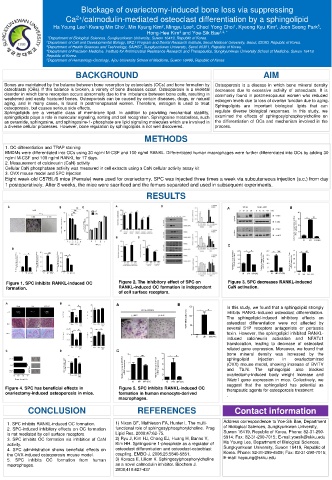
Blockage of ovariectomy-induced bone loss via suppressing
                      Ca /calmodulin-mediated osteoclast differentiation by a sphingolipid
                          2+
                  Ha Young Lee Kwang Min Cho , Min Kyung Kim , Mingyu Lee , Cheol Yong Choi , Kyeong Kyu Kim , Joon Seong Park ,
                             1,
                                         1
                                                                                           4
                                                                                                        5
                                                                             1
                                                      2
                                                               3
                                                           3
                                                 Hong-Hee Kim and Yoe-Sik Bae 1,3, *
                1 Department of Biological Sciences, Sungkyunkwan University, Suwon 16419, Republic of Korea.
                2 Department of Cell and Developmental Biology, BK21 Program and Dental Research Institute, Seoul National University, Seoul, 03080, Republic of Korea.
                3 Department of Health Sciences and Technology, SAIHST, Sungkyunkwan University, Seoul 06351, Republic of Korea.
                4 Department of Precision Medicine, Institute for Antimicrobial Resistance Research and Therapeutics, Sungkyunkwan University School of Medicine, Suwon 16419,
                Republic of Korea.
                5 Department of Hematology-Oncology, Ajou University School of Medicine, Suwon 16499, Republic of Korea
                          BACKGROUND                                                   AIM
  Bones are maintained by the balance between bone resorption by osteoclasts (OCs) and bone formation by  Osteoporosis is a disease in which bone mineral density
  osteoblasts (OBs). If this balance is broken, a variety of bone diseases occur. Osteoporosis is a skeletal  decreases due to excessive activity of osteoclasts. It is
  disorder in which bone resorption occurs abnormally due to the imbalance between bone cells, resulting in  commonly found in postmenopausal women who reduced
  weakened and easily fractured bones. Osteoporosis can be caused by certain diseases, drugs, or natural  estrogen levels due to loss of ovarian function due to aging.
  aging, and in many cases, is found in postmenopausal women. Therefore, estrogen is used to treat  Sphingolipids are important biological lipids that can
  osteoporosis, but causes serious side effects.
  Sphingolipids are a versatile class of membrane lipid. In addition to providing mechanical stability,  regulate diverse biological responses. In this study, we
  sphingolipids plays a role in molecular signaling, sorting and cell recognition. Sphingosine metabolites, such  examined the effects of sphingosylphosphorylcholine on
  as ceramide, sphingosine, and sphingosine-1- phosphate are lipid signaling molecules which are involved in  the differentiation of OCs and mechanism involved in the
  a diverse cellular processes. However, bone regulation by sphingolipids is not well discovered.  process.
                                                METHODS
   1. OC differentiation and TRAP staining
   BMDMs were differentiated into OCs using 30 ng/ml M-CSF and 100 ng/ml RANKL. Differentiated human macrophages were further differentiated into OCs by adding 30
   ng/ml M-CSF and 100 ng/ml RANKL for 17 days.
   2. Measurement of calcineurin (CaN) activity
   Cellular CaN phosphatase activity was measured in cell extracts using a CaN cellular activity assay kit
   3. OVX mouse model and SPC injection
   Eight week-old C57BL/6 mice (Female) were used for ovariectomy. SPC was injected three times a week via subcutaneous injection (s.c.) from day
   1 postoperatively. After 8 weeks, the mice were sacrificed and the femurs separated and used in subsequent experiments.
                                                 RESULTS


   Figure 1. SPC inhibits RANKL-induced OC   Figure 2. The inhibitory effect of SPC on   Figure 3. SPC decreases RANKL-induced
   formation.                           RANKL-induced OC formation is independent   CaN activation.
                                        of cell surface receptors.

                                                                           In this study, we found that a sphingolipid strongly
                                                                           inhibits RANKL-induced osteoclast differentiation.
                                                                           The sphingolipid-induced inhibitory effects on
                                                                           osteoclast differentiation were not affected by
                                                                           several S1P receptors antagonists or pertussis
                                                                           toxin. However, the sphingolipid inhibited RANKL-
                                                                           induced  calcineurin  activation  and  NFATc1
                                                                           translocation, leading to decrease of osteoclast
                                                                           related gene expression. Moreover, we found that
                                                                           bone mineral density was increased by the
                                                                           sphingolipid  injection  in  ovariectomized
                                                                           (OVX) mouse model, showing increase of BV/TV
                                                                           and  Tb.N.  The  sphingolipid  also  blocked
                                                                           ovariectomy-induced body weight increase and
                                                                           Nfatc1 gene expression in mice. Collectively, we
                                                                           suggest that the sphingolipid has potential as
   Figure 4. SPC has beneficial effects in   Figure 5. SPC inhibits RANKL-induced OC   therapeutic agents for osteoporosis treatment
   ovariectomy-induced osteoporosis in mice.   formation in human monocyte-derived   .
                                        macrophages.
          CONCLUSION                          REFERENCES                     Contact information


   1. SPC inhibits RANKL-induced OC formation.  1) Nixon GF, Mathieson FA, Hunter I. The multi-  Address correspondence to Yoe-Sik Bae, Department
                                                                          of Biological Sciences, Sungkyunkwan University,
   2. SPC-induced inhibitory effects on OC formation  functional role of sphingosylphosphorylcholine. Prog
   is not mediated by cell surface receptors.  Lipid Res. 2008;47:62-75.   Suwon 16419, Republic of Korea. Phone: 82-31-290-
                                                                          5914; Fax: 82-31-290-7015; E-mail:yoesik@skku.edu
   3. SPC inhibits OC formation via inhibition of CaN  2) Ryu J, Kim HJ, Chang EJ, Huang H, Banno Y,
   activity.                           Kim HH. Sphingosine 1-phosphate as a regulator of   Ha Young Lee, Department of Biological Sciences,
   4. SPC administration shows beneficial effects on  osteoclast differentiation and osteoclast-osteoblast   Sungkyunkwan University, Suwon 16419, Republic of
                                                                          Korea. Phone: 82-31-299-4509; Fax: 82-31-290-7015;
   the OVX-induced osteoporosis mouse model.  coupling. EMBO J. 2006;25:5840-5851.
   5.  SPC  inhibits  OC  formation  from  human  3) Kovacs E, Liliom K. Sphingosylphosphorylcholine  E-mail: hayoung@skku.edu
   macrophages.                        as a novel calmodulin inhibitor. Biochem J.
                                       2008;410:427-437

