


Page 3 - F. Cell biology
P. 3
Tubby like protein family is an adaptor for
                               ciliary G protein-coupled receptor trafficking

                                       Kyoungeun Kim¹ ¹, Seok Jun Moon¹ ¹
                                                         ,
                                                                             ,
                  Oral Biology, Yonsei University College of Dentistry, Seoul 03722, Republic of Korea

                      Introduction

      Cilia are highly specialized antennae-like cellular organelles serves as
     mediator for cell signaling cascade. Dysfunction of cilia due to diverse factor
     leads to clinical phenotype such as retinal degeneration, polycystic kidney
     disease and obesity. An elaborate mechanism for establishing and
     maintaining the compartmentalization of cilia is necessary for proper ciliary
     function, which includes the entry, localization, and exit of specific signaling
     molecules to and from the ciliary compartment.
      In the previous study, TULP3 is known as adapters for the ciliary trafficking
     of G protein-coupled receptors (GPCRs). Since Tubby like protein family
     (TULP) shares N-terminal IFT binding domain and C-terminal Tubby domain,
     it is intriguing to speculate that all TULPs function as adaptors for ciliary
     membrane cargo trafficking. This study investigate whether TULPs regulate
     ciliary protein trafficking. hTERT RPE-1(RPE1) cell is generally known for cell
     line that doesn’t express TUB, we additionally identified TULP1 and TULP2
     are not expressed in RPE1cell and used CRISPR/Cas9 system to generate
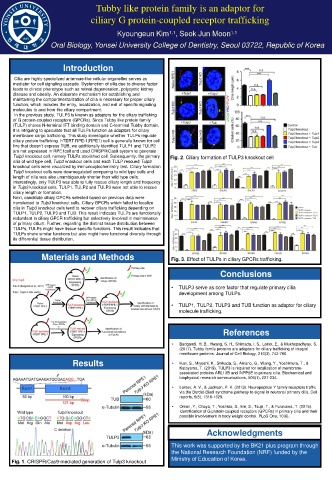
     Tulp3 knockout cell, namely TULPs abolished cell. Subsequently, the primary   Fig. 2. Ciliary formation of TULP3 knockout cell
     cilia of wild type cell, Tulp3 knockout cells and each TULP rescued Tulp3
     knockout cells were visualized by immunocytochemistry test. Ciliary formation
     Tulp3 knockout cells were downregulated comparing to wild type cells and
     length of cilia was also unambiguously shorter than wild type cells.
     Interestingly, only TULP3 was able to fully rescue ciliary length and frequency
     in Tulp3 knockout cells. TULP1, TULP2 and TULP3 were not able to rescue
     ciliary length or formation.
     Next, candidate ciliary GPCRs selected based on previous data were
     transfected to Tulp3 knockout cells. Ciliary GPCRs which failed to localize
     cilia in Tulp3 knockout cells tend to recover ciliary trafficking depending on
     TULP1, TULP2, TULP3 and TUB. This result indicates TULPs are functionally
     redundant in ciliary GPCR trafficking but selectively involved in maintenance
     of primary cilium. Further, regarding the distinct tissue distribution between
     TULPs, TULPs might have tissue-specific functions. This result indicates that
     TULPs share similar functions but also might have functional diversity through
     its differential tissue distribution.

               Materials and Methods                     Fig. 3. Effect of TULPs in ciliary GPCRs trafficking.

                                                                         Conclusions


                                                         •  TULP3 serve as core factor that regulate primary cilia
                                                           development among TULPs.
                                                         •  TULP1, TULP2, TULP3 and TUB function as adaptor for ciliary
                                                           molecule trafficking.


                                                                          References

                                                         •  Badgandi, H. B., Hwang, S. H., Shimada, I. S., Loriot, E., & Mukhopadhyay, S.
                                                           (2017). Tubby family proteins are adapters for ciliary trafficking of integral
                                                           membrane proteins. Journal of Cell Biology, 216(3), 743-760.
                         Results                         •  Han, S., Miyoshi, K., Shikada, S., Amano, G., Wang, Y., Yoshimura, T., &
                                                           Katayama, T. (2019). TULP3 is required for localization of membrane-
                                                           associated proteins ARL13B and INPP5E to primary cilia. Biochemical and
                                                           biophysical research communications, 509(1), 227-234.
                                                         •  Loktev, A. V., & Jackson, P. K. (2013). Neuropeptide Y family receptors traffic
                                                           via the Bardet-Biedl syndrome pathway to signal in neuronal primary cilia. Cell
                                                           reports, 5(5), 1316-1329.
                                                         •  Omori, Y., Chaya, T., Yoshida, S., Irie, S., Tsujii, T., & Furukawa, T. (2015).
                                                           Identification of G protein-coupled receptors (GPCRs) in primary cilia and their
                                                           possible involvement in body weight control. PLoS One, 10(6).

                                                                    Acknowledgments

                                                         This work was supported by the BK21 plus program through
                                                         the National Research Foundation (NRF) funded by the
                                                         Ministry of Education of Korea.
     Fig. 1. CRISPR/Cas9-mediated generation of Tulp3 knockout

