


Page 138 - Homes & Interiors Scotland
P. 138
ARCHITECTURE


                            T-A-P’s solution satisfied all these requirements. The
                         old kitchen would make way for a new utility room, with
                         the new kitchen being placed in the extension. Minor
                         alterations involved moving the wall between the new
                         kitchen and utility room to create a bigger bathroom,
                         but the major design coup lay in creating a double-height
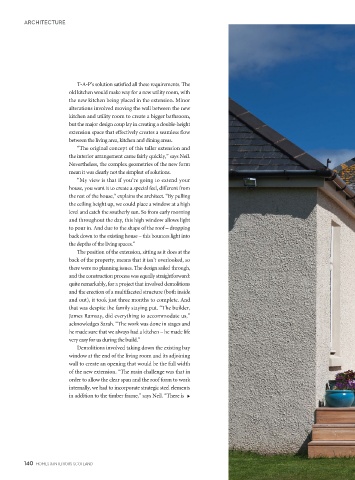
                         extension space that effectively creates a seamless flow
                         between the living area, kitchen and dining areas.
                            “The original concept of this taller extension and
                         the interior arrangement came fairly quickly,” says Neil.
                         Nevertheless, the complex geometries of the new form
                         mean it was clearly not the simplest of solutions.
                            “My view is that if you’re going to extend your
                         house, you want it to create a special feel, different from
                         the rest of the house,” explains the architect. “By pulling
                         the ceiling height up, we could place a window at a high
                         level and catch the southerly sun. So from early morning
                         and throughout the day, this high window allows light
                         to pour in. And due to the shape of the roof – dropping
                         back down to the existing house – this bounces light into
                         the depths of the living spaces.”
                            The position of the extension, sitting as it does at the
                         back of the property, means that it isn’t overlooked, so
                         there were no planning issues. The design sailed through,
                         and the construction process was equally straightforward:
                         quite remarkably, for a project that involved demolitions
                         and the erection of a multifaceted structure (both inside
                         and out), it took just three months to complete. And
                         that was despite the family staying put. “The builder,
                         James Ramsay, did everything to accommodate us,”
                         acknowledges Sarah. “The work was done in stages and
                         he made sure that we always had a kitchen – he made life
                         very easy for us during the build.”
                            Demolitions involved taking down the existing bay
                         window at the end of the living room and its adjoining
                         wall to create an opening that would be the full width
                         of the new extension. “The main challenge was that in
                         order to allow the clear span and the roof form to work
                         internally, we had to incorporate strategic steel elements
                         in addition to the timber frame,” says Neil. “There is


               HOMES & INTERIORS SCOTLAND

