


Page 127 - Homes & Interiors Scotland
P. 127
2
              that they had not been developed in unity. “Hart Street peters   The house has 165m of floor space within a footprint
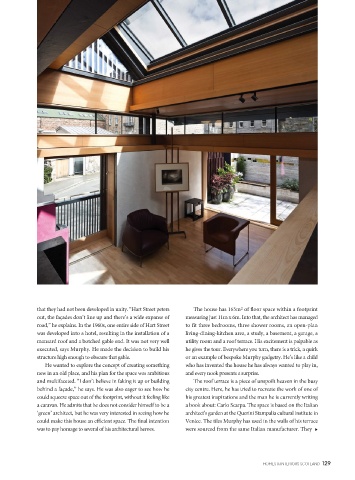
              out, the façades don’t line up and there’s a wide expanse of   measuring just 11m x 6m. Into that, the architect has managed
              road,” he explains. In the 1960s, one entire side of Hart Street   to fit three bedrooms, three shower rooms, an open-plan
              was developed into a hotel, resulting in the installation of a   living-dining-kitchen area, a study, a basement, a garage, a
              mansard roof and a botched gable end. It was not very well   utility room and a roof terrace. His excitement is palpable as
              executed, says Murphy. He made the decision to build his   he gives the tour. Everywhere you turn, there is a trick, a quirk
              structure high enough to obscure that gable.        or an example of bespoke Murphy gadgetry. He’s like a child
                 He wanted to explore the concept of creating something   who has invented the house he has always wanted to play in,
              new in an old place, and his plan for the space was ambitious   and every nook presents a surprise.
              and multifaceted. “I don’t believe in faking it up or building   The roof terrace is a piece of unspoilt heaven in the busy
              behind a façade,” he says. He was also eager to see how he   city centre. Here, he has tried to recreate the work of one of
              could squeeze space out of the footprint, without it feeling like   his greatest inspirations and the man he is currently writing
              a caravan. He admits that he does not consider himself to be a   a book about: Carlo Scarpa. The space is based on the Italian
              ‘green’ architect, but he was very interested in seeing how he   architect’s garden at the Querini Stampalia cultural institute in
              could make this house an efficient space. The final intention   Venice. The tiles Murphy has used in the walls of his terrace
              was to pay homage to several of his architectural heroes.  were sourced from the same Italian manufacturer. They


                                                                                              HOMES & INTERIORS SCOTLAND

