


Page 201 - home and garden
P. 201
trees were already gone and stacked up for firewood.’ In
                                                                         their place, Ronald planted more oaks, opening up views
                                                                         and paring back the rest of the garden to create a new
                                                                         simplified structure that sets geometric formality against
                                                                         organic contours. Since Willem’s death, his son Menno
                                                                         has  been  looking  after  the  house  and  garden,  with
                                                                         Ronald’s continuing guidance. ‘Willem said to me before
                                                                         he died, “Let’s agree that the garden will never be finished
                                                                         and that you will always be the conductor of it.” ’
                                                                           On plan, the shape of the garden is curious: long and
                                                                         narrow, tapering to a point at one end – the result of an
                                                                         extra slice of land being acquired from a farmer. The
                                                                         house sits in the middle, so that the garden spreads out
                                                                         from each side of the house with unbroken views left and
                                                                         right along its long, narrow axis. Through one window,
                                                                         hornbeam hedges lead to an avenue of yew cones and in
                                                                         the distance nebulous mounds of clipped Rhododendron
                                                                         ponticum; through the other, the view stretches down
                                                                         across a rectangular pool. Although the long sight line is
                                                                         unbroken, on either side of it hedges and paths intersect
                                                                         at right angles, and this is where the symphonic analogy
                                                                         comes into play. ‘If you walk along the main axis, you
                                                                         come across different sections with different moods, little
                                                                         flower gardens surrounded by hedges, avenues of oaks
                                                                         that march across,’ says Ronald.
                                                                           Near the house, snaking forms of clipped box create an
                                                                         abstract landform from which gnarled oaks rise up dram-
                                                                         atically, casting shadows on the cruciform pond below.
                                                                         ‘The movement of the box takes you by the arm and leads
                                                                         you round to the other side of the house,’ says Ronald.
                                                                         Like the ripples in the pond, the box forms are also rhyth-
                                                                         mic, but softer than the marching avenues of trees. The
                                                                         pool design is ingenious, its curved edges set off by a
                                                                         pair of raised rectangular reflecting pools on the cross
                                                                         section, with waterfalls to give movement and sound.
                                                                         Designed to fool the eye, the raised pools seem at first
                                                                         glance entirely rectangular, but at each end, the lines
                                                                         intersect at just a few degrees short of a right angle.
                                                                         ‘Many designers in history have done this,’ says Ronald.
                                                                         ‘It’s a device used in the gardens of Château de Villandry
                                                                         and in other classical gardens.’
                                                                           On  the  other  side  of  the  house,  the  second  pool
                                                                         conforms to the classical rectangular shape, but it is
                                                                         offset by a tapering avenue of pleached limes that play
                                                                         with perspective, leading the eye towards the windmill
                                                                         that lies just outside the garden boundary. Landscape,
                                                                         water, light and shadow have all been harnessed here,
                                                                         bringing natural crescendos and diminuendos to this
                                                                         symphony in green

                                                                         Ronald van der Hilst: 00-32-32 13 24 78;
                                                                         ronaldvanderhilst.com


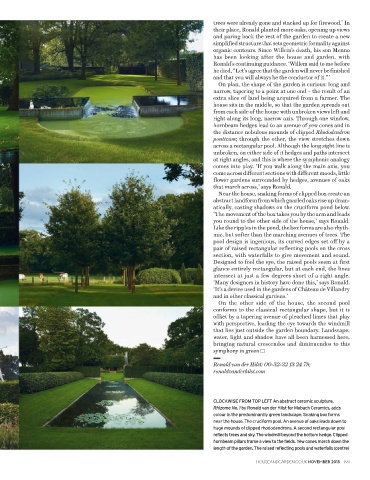
                                                                         CLOCKWISE FROM TOP LEFT An abstract ceramic sculpture,
                                                                         Rhizome No. 1 by Ronald van der Hilst for Mobach Ceramics, adds
                                                                         colour in the predominantly green landscape. Snaking box forms
                                                                         near the house. The cruciform pool. An avenue of oaks leads down to
                                                                         huge mounds of clipped rhododendrons. A second rectangular pool
                                                                         reflects trees and sky. The windmill beyond the bottom hedge. Clipped
                                                                         hornbeam pillars frame a view to the fields. Yew cones march down the
                                                                         length of the garden. The raised reflecting pools and waterfalls (centre)

                                                                                       HOUSEANDGARDEN.CO.UK NOVEMBER 2015 199

