


Page 196 - home and garden
P. 196
hose who saw garden designer   problem – and that created privacy for   that the plants should co-exist without any
                 James Basson’s gold-medal-  each of three properties that they own on   species swamping another. More than half
                 winning ‘Perfumer’s Garden   the site: the main house, a cottage above,   the mix is made up of evergreens, such as
                 in Grasse’ at this year’s RHS   and a guest house below and to the west.  lavender, thyme and santolina, and with
        TChelsea  Flower  Show  will           James took his cue from the landscape   the exception of rosemary, which is clipped
        know that what he does so consummately   – the limestone cliff behind the house is   to about 30cm and creates a graphic line
        is create an enhanced version of the natu-  covered in Euphorbia dendroides, Quercus   through both parts of the lower garden,
        ral landscape. The landscape in this case   ilex and carob trees – and created, what he   there is no dominant species.
        was  the  craggy,  aromatic  hillsides  of     describes as, two ‘fudgy areas’ of trees and   As the slope is gentler below the guest
        the  Alpes-Maritimes,  close  to  where   shrubs between the main house and the   house,  the  hummocky  profile  of  these
        James and his wife Helen had spent a year     two other houses. The land drops three   tightly planted terraces creates a jewel-
        working  in  a  private  garden  during    metres  away  from  the  flat  terrace  and    like foreground to the view across to Cap
        his Greenwich University garden-design   rectangular swimming pool of the main   Ferrat  from  the  curved  infinity  pool.
        degree. Having won his first RHS medal   house to the mesh boundary of another   Guests can wander down gravel paths to
        (silver gilt) for a community garden at   property belonging to a neighbour. Taking   an area of undulating zoysia grass, and
        Hampton Court in 2000, he moved to the   his inspiration from the traditional stone     beyond this to a terrace wrapped in vege-
        South of France and set up Scape Design.   terraces used by farmers and vineyard   tation. There are a further two enclosed
        The diversity and tenacity of the wind-   owners, James designed three terraces,   seating areas at the bottom of the main-
        buffeted and sun-baked shrubs became   traversed by stone steps, that snake across   house garden and here, too, is a developing
        his inspiration for creating sustainable     the slope and into the garden below the   canyon walkway, planted with staggered
        gardens, and his introduction to nursery-  guest house. Here, the terraces are faced   olives  on  two-metre  stems,  which  will
        man Olivier Filippi was, he says, a meeting   with chestnut hurdles rather than stone.   eventually create a new boundary.
        of minds. ‘He was growing the plants that     ‘I wanted to keep the sinuous lines of the   To  soften  the  expanse  of  Pierre  de
        I wanted to grow, and explaining how to   grassy landscape that was here before, so   Bourgogne flags around the rectangular
        grow them in a garden environment.’  the garden didn’t become too rectilinear   pool, James wanted a tree with a natural-
          In 2010, James was asked to redesign   and formal,’ he explains.        looking form. In a nursery near Rome, he
        an irregularly shaped garden that wraps   As an agreed experiment, James decided    found a group of abandoned Lagerstroemia
        around a property on the hillside above   to give his clients an exhilarating matrix   indica with exactly the shape he wanted
        Villefranche-sur-Mer.  It  had  sparkling   of robust and colourful plants, mainly in   and peeling stems that drew out the warmth
        views across the Mediterranean, steeply   shades of pink and white with the occa-  in  the  stone.  They  stand  as  permitted
        sloping grass that had to be constantly   sional splash of yellow, which roll across   aliens in a garden that melds gloriously
        watered  and  a  handful  of  out-of-place   the terraces in bands of green or silver   into the surrounding landscape
        Phoenix  palms.  The  owners  wanted to   foliage. The width of the bands varies,
        have a garden that would survive with    each one containing species of a similar   Scape Design: 00-377-9797 1536;
        little or no watering – mosquitoes were a   height, ranging from 30cm to a metre, so   scapedesign.com

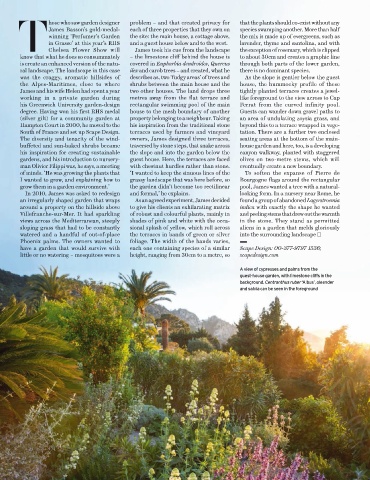
                                                                                  A view of cypresses and palms from the
                                                                                  guest-house garden, with limestone cliffs in the
                                                                                  background. Centranthus ruber ‘Albus’, oleander
                                                                                  and salvia can be seen in the foreground

