


Page 178 - home and garden
P. 178
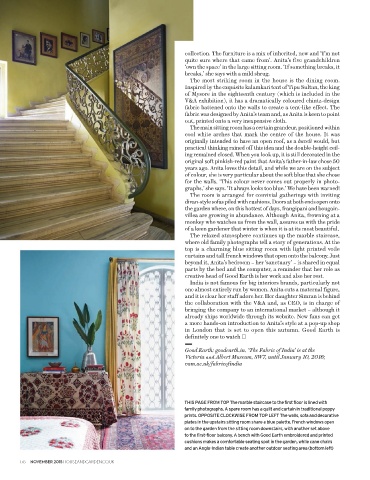
collection. The furniture is a mix of inherited, new and ‘I’m not
                                                               quite sure where that came from’. Anita’s five grandchildren
                                                               ‘own the space’ in the large sitting room. ‘If something breaks, it
                                                               breaks,’ she says with a mild shrug.
                                                                 The  most  striking  room  in  the  house  is  the  dining  room.
                                                               Inspired by the exquisite kalamkari tent of Tipu Sultan, the king
                                                               of Mysore in the eighteenth century (which is included in the
                                                               V&A exhibition), it has a dramatically coloured chintz-design
                                                               fabric battened onto the walls to create a tent-like effect. The
                                                               fabric was designed by Anita’s team and, as Anita is keen to point
                                                               out, printed onto a very inexpensive cloth.
                                                                 The main sitting room has a certain grandeur, positioned within
                                                               cool  white  arches  that  mark  the  centre  of  the  house.  It  was
                                                               originally intended to have an open roof, as a haveli would, but
                                                               practical thinking rained off this idea and the double-height ceil-
                                                               ing remained closed. When you look up, it is still decorated in the
                                                               original soft pinkish-red paint that Anita’s father-in-law chose 50
                                                               years ago. Anita loves this detail, and while we are on the subject
                                                               of colour, she is very particular about the soft blue that she chose
                                                               for the walls. ‘This colour never comes out properly in photo-
                                                               graphs,’ she says. ‘It always looks too blue.’ We have been warned!
                                                                 The room is arranged for convivial gatherings with inviting
                                                               divan-style sofas piled with cushions. Doors at both ends open onto
                                                               the garden where, on this hottest of days, frangipani and bougain-
                                                               villea are growing in abundance. Although Anita, frowning at a
                                                               monkey who watches us from the wall, assures us with the pride
                                                               of a keen gardener that winter is when it is at its most beautiful.
                                                                 The relaxed atmosphere continues up the marble staircase,
                                                               where old family photographs tell a story of generations. At the
                                                               top is a charming blue sitting room with light printed voile
                                                               curtains and tall french windows that open onto the balcony. Just
                                                               beyond it, Anita’s bedroom – her ‘sanctuary’ – is shared in equal
                                                               parts by the bed and the computer, a reminder that her role as
                                                               creative head of Good Earth is her work and also her rest.
                                                                 India is not famous for big interiors brands, particularly not
                                                               one almost entirely run by women. Anita cuts a maternal figure,
                                                               and it is clear her staff adore her. Her daughter Simran is behind
                                                               the collaboration with the V&A and, as CEO, is in charge of
                                                               bringing the company to an international market – although it
                                                               already ships worldwide through its website. New fans can get
                                                               a more hands-on introduction to Anita’s style at a pop-up shop
                                                               in  London  that  is  set  to  open  this  autumn.  Good  Earth  is
                                                               definitely one to watch

                                                               Good Earth: goodearth.in. ‘The Fabric of India’ is at the
                                                               Victoria and Albert Museum, SW7, until January 10, 2016;
                                                               vam.ac.uk/fabricofindia


                                                               THIS PAGE FROM TOP The marble staircase to the first floor is lined with
                                                               family photographs. A spare room has a quilt and curtain in traditional poppy
                                                               prints. OPPOSITE CLOCKWISE FROM TOP LEFT The walls, sofa and decorative
                                                               plates in the upstairs sitting room share a blue palette. French windows open
                                                               on to the garden from the sitting room downstairs, with another set above
                                                               to the first-floor balcony. A bench with Good Earth embroidered and printed
                                                               cushions makes a comfortable seating spot in the garden, while cane chairs
                                                               and an Anglo-Indian table create another outdoor seating area (bottom left)

        176  NOVEMBER 2015 HOUSEANDGARDEN.CO.UK

