


Page 176 - home and garden
P. 176
A                        lthough the name might mean


                                                                                         nothing to most Europeans, ask
                                                                                         any style-conscious Indian and
                                                                                         they will tell you that the Good
                                                                                         Earth stores are an essential port
                                                                                         of call for lovers of design, colour
                                                                                         and pattern. The shops feature
                                                               floor upon floor of beautifully crafted Indian ceramics, hand-
                                                               block-printed and woven textiles, and cool cafes serving up fresh
                                                               and inventive dishes. To the company’s owner Anita Lal, after
                                                               almost 20 years of business, 10 shops and a steadily expanding
                                                               empire, this success appears to have come as rather a surprise.
                                                                 The seeds of Good Earth were sown in the late Seventies, when
                                                               ‘accidental entrepreneur’ Anita, a trained studio potter who had
                                                               two young children at that time, began working with rural arti-
                                                               sans to make their designs more contemporary. ‘Modern inter-
                                                               pretations of traditional designs didn’t really exist back then,’
                                                               she explains. ‘If you wanted colourful and interesting patterned
                                                               pieces, you had to import them.’
                                                                 This brings us to the present day and from India to London,
                                                               where Good Earth is sponsoring the Victoria and Albert Museum’s
                                                               autumn exhibition, The Fabric of India, a major show exploring
                                                               the world of handmade Indian textiles from the third century to
                                                               the present day. The exhibition includes more than 200 pieces,
                                                               many on display for the first time, including a stunning selection
                                                               of historic clothes, heirloom fabrics and cutting-edge fashion.
                                                                 Walking round Anita’s house in Delhi, it is easy to see why
                                                               Good  Earth  is  a  natural  partner  for  such  an  event.  Pretty
                                                               patterned textiles and bright colours – the hallmarks of Good
                                                               Earth – punctuate every space. The feeling is contemporary, but
                                                               each of the designs is drawn from and celebrates the remarkable
                                                               textile heritage of India and the Silk Road.
                                                                 The house was built in the Sixties by Austrian architect Karl
                                                               Malte von Heinz as a modern haveli (a typical Indian courtyard
                                                               house) for Anita’s father-in-law. Anita and her husband moved in
                                                               2010 and the house has been gently evolving since. Considering
                                                               her eye for design, Anita is not precious when it comes to the
                                                               house and, for the most part, the decoration is modest and family
                                                               oriented. The dragonfly voile at the dining-room windows is from
                                                               the very first Good Earth collection in 1996 and the cushions
                                                               on the sitting-room sofas are a combination of old designs and
                                                               pieces  from  last  season’s  Silk  Road-inspired  Samarqand


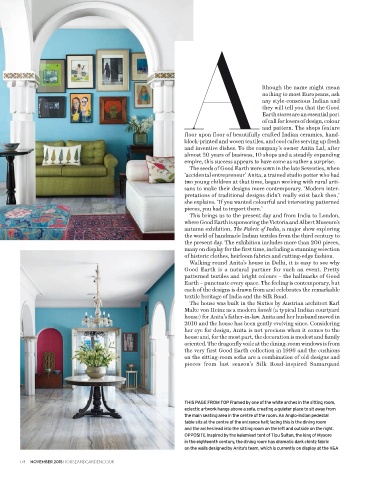
                                                               THIS PAGE FROM TOP Framed by one of the white arches in the sitting room,
                                                               eclectic artwork hangs above a sofa, creating a quieter place to sit away from
                                                               the main seating area in the centre of the room. An Anglo-Indian pedestal
                                                               table sits at the centre of the entrance hall; facing this is the dining room
                                                               and the arches lead into the sitting room on the left and outside on the right.
                                                               OPPOSITE Inspired by the kalamkari tent of Tipu Sultan, the king of Mysore
                                                               in the eighteenth century, the dining room has dramatic dark chintz fabric
                                                               on the walls designed by Anita's team, which is currently on display at the V&A

        174    NOVEMBER 2015 HOUSEANDGARDEN.CO.UK

