


Page 31 - 교육청-디지털브로슈어
P. 31
Education System


 School age  Age
 29
 23
 22  28
 27
 21  26
 20  Graduate
 19  schools  25
 18  Secondary  24
 education
 23
 17  22
 16  21
 Open
 15  Tertiary education  Industrial   Univer-  univer-  Technical
 univer-
 sities of
 14  univer-  education  Community   sities  sities  Miscellaneous  Distance   In- house  20
 sities
 colleges
 13  colleges  schools  (universities)  colleges  19
 18
 12  Open  17
 11  High schools  Secondary  Technical  Miscellane-  16
 10  Schools  high schools  ous schools  Intermediate
 9  education  15
 8  Middle schools  High civic   Miscellane-  14
 13
 7  schools  ous schools  12
 6  Special schools  11
 5  Civic
 4  Elementary schools  schools  Primary  10
 3  education  9 8
 2  7
 1
 6             Middle School Education
 Kindergartens  Preschools  5
 4
 3
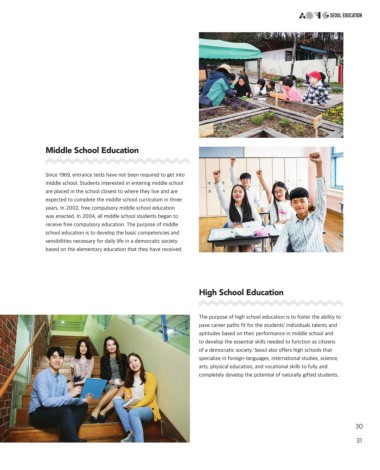
               Since 1969, entrance tests have not been required to get into
 School System  Regular School System: A 6-3-3-4 system from elementary to higher education   middle school. Students interested in entering middle school
 Special School System: Air and correspondence high schools, technical high schools, and civic high   are placed in the school closest to where they live and are
 schools, which follow the regular school curricula  expected to complete the middle school curriculum in three
 Semester   A school year is divided into two semesters, with the first semester running from March 1 to August 31   years. In 2002, free compulsory middle school education
 and the second from September 1 to the end of the next February  was enacted. In 2004, all middle school students began to
               receive free compulsory education. The purpose of middle
               school education is to develop the basic competencies and
 Early Childhood Education  Elementary Education   sensibilities necessary for daily life in a democratic society
               based on the elementary education that they have received.
 A kindergarten is a school founded and operated for the   Elementary education is free and compulsory. Children, in
 education of young children from three years of age up to   principle, attend elementary schools starting at age 6. If
 those of age to enroll in elementary school. The purpose of a   the children are determined to have the required abilities,
 kindergarten curriculum is to inculcate the basic concepts of   5-year-old children can also attend elementary school within   High School Education
 a democratic society by developing the students’ physical and   the relevant school’s capacity. Elementary school must be
 mental health, as well as the social skills of children ages 3 to 5.   completed in 6 years. Currently, 413,314 students (as of April
 The “Nuri Curriculum” for these children consists of five subjects:   1, 2019) are attending about 600 elementary schools in Seoul.   The purpose of high school education is to foster the ability to
 physical exercise & personal hygiene, communication & language   Article 38 of the Elementary and Secondary Education Act   pave career paths fit for the students’ individuals talents and
 skills, social skills & etiquette, artistic expression, and nature   stipulates: “The purpose of elementary schools is to conduct the   aptitudes based on their performance in middle school and
 inquiry/appreciation. As of now, more than 91,195 children are   basic elementary education necessary for the life of people.”The   to develop the essential skills needed to function as citizens
 enrolled in the 884 kindergartens that are within the jurisdiction   primary goal of elementary school education is to foster the   of a democratic society. Seoul also offers high schools that
 of the Seoul Metropolitan Office of Education. Our kindergartens   proper habits and basic skills required of students in their   specialize in foreign-languages, international studies, science,
 are working hard to keep the parents satisfied and children happy   daily lives and in the learning process while empowering them   arts, physical education, and vocational skills to fully and
 through various types of curriculums and after-school programs.   to develop an upright personality based on that educational   completely develop the potential of naturally gifted students.
 Most notably, we promote the holistic education of children and   purpose.The elementary school education consists of subjects
 help parents concentrate on their jobs and housework through   such as Korean, social studies/ethics, mathematics, science/
 our “Educare” service program which provides quality education   practical arts, physical education, art (music, fine arts), English,
 and childcare as well as equal education opportunities at the start   and “creative experiential activities.” However, the curriculums
 of the children’s lives through the provision of financial support.   for 1st and 2nd graders are Korean, mathematics, and
 We are also reinforcing the responsibility of the state for early   “disciplined life, wise life, and pleasant life.”
                                                                                                                30
 childhood education by working to reduce parents’ economic
 burden related to educational expenditures through a variety of                                                 31
 measures and initiatives.

