


Page 242 - Homes & Interiors Scotland
P. 242
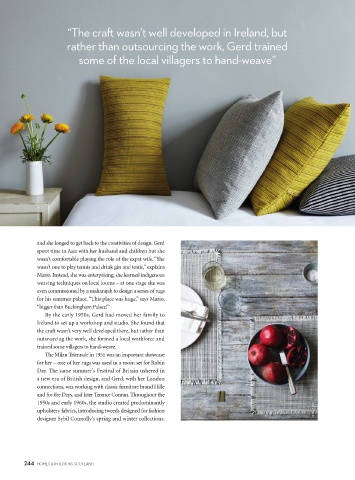
“The cra  wasn’t well developed in Ireland, but
                         rather than outsourcing the work, Gerd trained


                             some of the local villagers to hand-weave”


               © Tara Fisher


              and she longed to get back to the creativities of design. Gerd
              spent time in Asia with her husband and children but she
              wasn’t comfortable playing the role of the expat wife. “She
              wasn’t one to play tennis and drink gin and tonic,” explains
              Mario. Instead, she was enterprising; she learned indigenous
              weaving techniques on local looms – at one stage she was
              even commissioned by a maharajah to design a series of rugs
              for his summer palace. “This place was huge,” says Mario,
              “bigger than Buckingham Palace!”
                 By the early 1950s, Gerd had moved her family to
              Ireland to set up a workshop and studio. She found that
              the craft wasn’t very well deve loped there, but rather than
              outsourcing the work, she formed a local workforce and
              trained some villagers to hand-weave.
                 The Milan Triennale in 1951 was an important showcase
              for her – one of her rugs was used in a room set for Robin
              Day. The same summer’s Festival of Britain ushered in
              a new era of British design, and Gerd, with her London
              connections, was working with classic furniture brand Hille
              and for the Days, and later Terence Conran. Throughout the
              1950s and early 1960s, the studio created predominantly
              upholstery fabrics, introducing tweeds designed for fashion                                      © Tara Fisher
              designer Sybil Connolly’s spring and winter collections.


               HOMES & INTERIORS SCOTLAND

