


Page 9 - ebook
P. 9
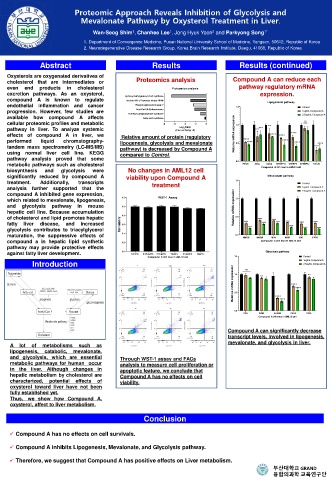
Proteomic Approach Reveals Inhibition of Glycolysis and
                           Mevalonate Pathway by Oxysterol Treatment in Liver.

                                            1
                               Wan-Seog Shim , Chanhee Lee , Jong Hyuk Yoon and Parkyong Song 1*
                                                                      2
                                                        1
                            1. Department of Convergence Medicine, Pusan National University School of Medicine, Yangsan, 50612, Republic of Korea
                            2. Neurodegenerative Disease Research Group, Korea Brain Research Institute, Daegu, 41068, Republic of Korea
              Abstract                             Results                     Results (continued)

   Oxysterols are oxygenated derivatives of
   cholesterol that are intermediates or     Proteomics analysis             Compound A can reduce each
   even  end  products  in  cholesterol                  Proteomics analysis   pathway regulatory mRNA
   excretion pathways. As an oxysterol,                                               expression.
   compound A is known to regulate        Hydroxymethylglutaryl-CoA synthase            Lipogenesis pathway
                                          Isoform M1 of Pyruvate kinase PKM
   endothelial  inflammation  and  cancer    Phosphoglycerate kinase 2        1.5                  Control
                                             Acyl-CoA (8-3)-desaturase
   progression. However, few studies are   Farnesyl pyrophosphate synthase                         1ug/mL Compound A
   available  how  compound  A  affects         Fatty acid synthase                                2.5ug/mL Compound A
   cellular proteomic profiles and metabolic          -8  -6  -4  -2  0       1.0                   ns
                                                           Log 2 Folds
   pathway in liver. To analyze systemic                  (Con vs Comp  A)          ✱✱✱✱ ✱✱✱  ✱✱
   effects of compound A in liver, we    Relative amount of protein (regulatory   Relative mRNA expression  ✱✱✱✱  ✱✱✱✱  ✱✱✱✱
   performed  liquid  chromatography-   lipogenesis, glycolysis and mevalonate   0.5  ✱✱✱✱ ✱✱✱✱  ✱✱✱✱  ✱✱✱✱  ✱✱✱✱
   tandem mass spectrometry (LC-MS/MS)  pathway) is decreased by Compound A                            ✱✱✱✱
   using normal liver cell line. KEGG   compared to Control.
   pathway analysis proved that some
   metabolic pathways such as cholesterol                                     0.0  FASN  ACCa  ACCb  SREBP1c  SREBP2  SREBP1a  Elovl6
   biosynthesis  and  glycolysis  were     No changes in AML12 cell                   Compound  A 24h treat in AML12 cell
   significantly reduced by compound A    viability upon Compound A                     Mevalonate pathway
   treatment.  Additionally,  transcripts         treatment                   1.5                  Control
   analysis  further  supported  that  the                                                         1ug/mL Compound A
                                                                                                   2.5ug/mL Compound A
   compound A inhibited gene expression,
   which related to mevalonate, lipogenesis,  1.2   WST-1 Assay               1.0        ✱✱
   and  glycolysis  pathway  in  mouse   1.0                                 Relative mRNA expression
   hepatic cell line. Because accumulation
   of cholesterol and lipid promotes hepatic  0.8                             0.5    ✱✱✱✱  ✱✱✱✱
   fatty  liver  disease,  and  increased  Cell viability  0.6                  ✱✱✱✱  ✱✱✱✱  ✱✱✱✱  ✱✱✱✱  ✱✱✱✱  ✱✱✱✱
   glycolysis contributes to triacylglycerol                                      ✱✱✱✱         ✱✱✱✱  ✱✱✱✱  ✱✱✱✱
   maturation, the suppressive effects of  0.4                                0.0  HMGS  HMGR  MVK  MVD  IDI1  FPPS
   compound a in hepatic lipid synthetic  0.2                                         Compound  A 24h treat in AML12 cell
   pathway may provide protective effects
   against fatty liver development.      0.0  Control  0.25ug/mL  0.5ug/mL  1ug/mL  2.5ug/mL  5ug/mL  Glycolysis pathway
                                                 Compound  A 24h treat in AML12 cell  1.5           Control
            Introduction                      Nt        0.25ug/mL  0.5ug/mL      ns                 1ug/mL Compound A
                                                                                                    2.5ug/mL Compound A
                                                                             Relative mRNA expression  1.0  n.s  ✱  ✱✱✱✱ ✱✱✱✱  n.s  ✱


                                                                             0.5


                                             1ug/mL     2.5ug/mL   5ug/mL                  ✱✱✱✱ ✱✱✱✱
                                                                             0.0
                                                                                PGK  PKM1  ALDOB  PKLR  PFKL
                                                                                     Compound  A 24h treat in AML12 cell
                                                                           Compound A can significantly decrease
                                                                           transcript levels, involved in lipogenesis,
                                                                           mevalonate, and glycolysis in liver.
    A  lot  of  metabolisms  such  as
    lipogenesis,  catabolic,  mevalonate,
    and glycolysis, which are essential  Through WST-1 assay and FACs
    metabolic pathways for human occur  analysis to measure cell proliferation or
    in the liver. Although changes in   apoptotic feature, we conclude that
    hepatic metabolism by cholesterol are  Compound A has no effects on cell
    characterized,  potential  effects  of  viability.
    oxysterol toward liver have not been
    fully established yet.
    Thus, we show how Compound A,
    oxysterol, affect to liver metabolism.
                                                Conclusion

    ✓ Compound A has no effects on cell survivals.

    ✓ Compound A inhibits Lipogenesis, Mevalonate, and Glycolysis pathway.

    ✓ Therefore, we suggest that Compound A has positive effects on Liver metabolism.
                                                                                          부산대학교 GRAND
                                                                                          융합의과학 교육연구단

