


Page 19 - T. Protein modification and regulation
P. 19
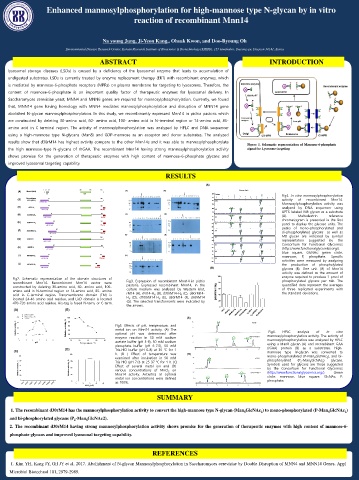
Enhanced mannosylphosphorylation for high-mannose type N-glycan by in vitro
reaction of recombinant Mnn14
Na young Jung, Ji-Yeon Kang,, Ohsuk Kwon, and Doo-Byoung Oh
Environmental Disease Research Center, Korean Research Institute of Bioscience & Biotechnology (KRIBB), 125 Gwahakro, Yuseong-gu, Daejeon 34141, Korea
ABSTRACT INTRODUCTION
lysosomal storage diseases (LSDs) is caused by a deficiency of the lysosomal enzyme that leads to accumulation of
undigested substrates. LSDs is currently treated by enzyme replacement therapy (ERT) with recombinant enzymes, which
is mediated by mannose-6-phosphate receptors (MPRs) on plasma membrane for targeting to lysosomes. Therefore, the
content of mannose-6-phosphate is an important quality factor of therapeutic enzymes for lysosomal delivery. In
Saccharomyces cerevisiae yeast, MNN4 and MNN6 genes are required for mannosylphosphorylation. Currently, we found
that, MNN14 gene having homology with MNN4 mediates mannosylphosphorylation and disruption of MNN14 gene
abolished N-glycan mannosylphosphorylation. In this study, we recombinantly expressed Mnn14 in pichia pastoris which
are constructed by deleting 30-amino acid, 60- amino acid, 100- amino acid in N-terminal region or 14-amino acid, 85-
amino acid in C-terminal region. The activity of mannosylphosphorylation was analyzed by HPLC and DNA sequencer
using a high-mannose type N-glycans (Man8) and GDP-mannose as an acceptor and donor substrates. The analyzed
results show that d30rM14 has highest avtivity compare to the other Mnn14s and it was able to mannosylphosphorylate
Figure 1. Schematic representation of Mannose-6-phosphate
the high mannose-type N-glycans of rhGAA. The recombinant Mnn14 having strong mannosylphosphorylation activity signal for Lysosome targeting
shows promise for the generation of therapeutic enzymes with high content of mannose-6-phosphate glycans and
improved lysosomal targeting capability.
RESULTS
(A)
1 24 47 470 720 935 Glucose Units
(A) Mnn14 (M14) (A) (B)
TM LicD 800 Dextran
5 10 Fig4. In vitro mannosylphosphorylation
200
(B) Recombinant 47 935 800 activity of recombinant Mnn14.
M14 (rM14)
-MF SS (1-89) (M8)
200 Mannosylphosphorylation activity was
(C) rM14-H 47 935 analyzed by DNA sequencer using
6
800 (A) P P P
-MF SS (1-89) His 6 -tag
200 APTS-labeled M8 glycan as a substrate
(D) d30rM14-H 6 77 935 (C) (D) (A). Maltodextrin reference
800 P P P
-MF SS (1-89) His 6 -tag (B)
chromatogram is presented in the first
200
(E) d60rM14-H 6 107 935 800 P panel to display the glucose units. The
-MF SS (1-89) His 6 -tag (C) P P
peaks of mono-phosphorylated and
200
147 935
(F) d100rM14-H 6 800 (D) P di-phosphorylated glycans as well as
-MF SS (1-89) His 6 -tag 200
(E) (F) M8 glycan are indicated by symbol
77 935 800 (E) P
(G) d30rM14 representation suggested by the
-MF SS (1-89) 200
Consortium for Functional Glycomics
800 P P P
107 935 (F)
(H) d60rM14 200 (http://www.functionalglycomics.org/).
-MF SS (1-89)
blue square, GlcNAc; green circle,
P
800 (G) P P
(I) rM14d14-H 6 47 921 (G) 200 mannose; P, phosphate. Specific
-MF SS (1-89) His -tag 800 (H) P
activities were measured by analyzing
6
200
(J) rM14d85-H 6 47 850 the production of phospholylated
-MF SS (1-89) His -tag (B) glycans (B). One unit (U) of Mnn14
6
activity was defined as the amount of
Fig2. Schematic representation of the domain structures of 100 enzyme required to produce 1 pmol of
recombinant Mnn14. Recombinant Mnn14 vector were Fig3. Expression of recombinant Mnn14 in pichia 80 phosphorylated glycans per min. The
constructed by deleting 30-amino acid, 60- amino acid, 100- pastoris. Expressed recombinant Mnn14, in the quantified data represent the averages
amino acid in N-terminal region or 14-amino acid, 85- amino culture medium was analyzed by Western blot. pmol/min/mg 60 of three replicated experiments with
acid in C-terminal region. Transmembrane domain (TM) is rM14 (A), rM14-H (B), d30rM14-H (C), d60rM14- 40 the standard deviations.
6
6
located 24-46 amino acid residue, and LicD domain is located H (D), d100rM14-H (E), d30rM14 (F), d60rM14
6
6
470-720 amino acid residue. His-tag is fused N-term, or C-term. (G). The selected transformants were indicated by 20
the arrows.
0
rM14 rM14-H d30rM14-H d60rM14-H d100rM14-H 6 H 6 -rM14 H 6 -d30rM14 H 6 -d60rM14
6
6
6
Fig5. Effects of pH, temperature, and
metal ion on Mnn14 activity. (A) The
optimal pH was determined after Fig6. HPLC analysis of In vitro
enzyme reaction in 50 mM sodium mannosylphosphorylation activity. The activity of
acetate buffer (pH 5-8), 50 mM sodium mannosylphosphorylation was analyzed by HPLC
phosphate buffer (pH 6-7.5), 50 mM using a Man8 glycan (A) and recombinant GAA
Tris-HCl buffer (pH 6-8) at 30 ℃ for 1 (rGAA) protein (B) as a substrates. High-
h. (B ) Effect of temperature was mannose type N-glycan was converted to
examined after incubation in 50 mM mono-phosphorylated (P-Man GlcNAc ), and bi-
8
2
Tris-HCl (pH 7.0) at 25-37 ℃ for 1 h. (C) phosphorylated (P -Man GlcNAc ) glycans.
2
8
2
Effect of several metal ion and (D) Symbols used for glycans are those suggested
various concentrations of MnCl 2 on by the Consortium for Functional Glycomics
Mnn14 activity. Activities at optimal (http://www.functionalglycomics.org/). Green
metal ion concentrations were defined circle: mannose, blue square: GlcNAc, P:
as 100%. phosphate.
SUMMARY
1. The recombinant d30rM14 has the mannosylphosphorylation activity to convert the high-mannose type N-glycan (Man GlcNAc ) to mono-phosphorylated (P-Man GlcNAc )
2
8
2
8
and bi-phosphorylated glycans (P -Man GlcNAc2).
8
2
2. The recombinant d30rM14 having strong mannosylphosphorylation activity shows promise for the generation of therapeutic enzymes with high content of mannose-6-
phosphate glycans and improved lysosomal targeting capability.
REFERENCES
1. Kim YH, Kang JY, Gil JY et al. 2017. Abolishment of N-glycan Mannosylphosphorylation in Saccharomyces cerevisiae by Double Disruption of MNN4 and MNN14 Genes. Appl
Microbiol Biotechnol 101, 2979-2989.

