


Page 7 - H. Cell signaling
P. 7
p32 conditional knock out of endothelium was increased
                     vascular function via activation of CaMKll/AMPK/p38
                                          MAPK/Akt/eNOS axis

                                         Byeongjun Yoon and Sungwoo Ryoo
         Department of Biology, College of Natural Sciences, Kangwon National University, Chuncheon 200-701, Republic of Korea

                     ABSTRACTS                                         INTRODUCTIONS
    ● The decrease in expression of p32 induced the activity of the CaMKll/AMPK  ● Ca 2+  is a major secondary messenger and can induce various cellular
                                                                                 2+
       /p38 MAPK/Akt/eNOS signaling pathway                 responses, which can activate Ca /calmodulin-dependent protein kinasell
                                                            (CaMKll) and endothelial nitric  oxide synthase (eNOS).
    ● p32 conditional knock out (cKO) increased the activity of eNOS in a Ca -
                                                      2+
      dependent manner, which increased NO production     ● eNOS produces nitric oxide (NO) using L-arginine as a substrate and NO
                                                            plays important role in vascular homeostasis.
                        +
    ● In the aorta of p32 Tie Cre mice, the acetylcholine relaxation response was
                  f/f
      increased and the phenylephrine contraction response was decreased.  ● p32 has a donut-shaped homotrimer structure with a pore in the center,
                                                            which acts as a Ca 2+  channel and can regulate cytosolic Ca .
                                                                                                 2+
                                      2+
    ● In conclusion, p32 can regulate the cytosolic Ca , which can induce eNOS
      activity and improve vascular function.             ● Since cytosolic Ca 2+  can regulate eNOS activity, p32 may be associated
                                                             with eNOS
                                                 RESULTS


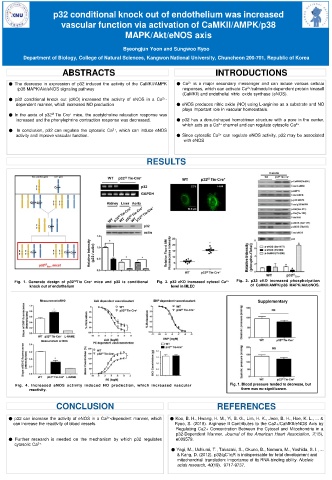
      Fig. 1. Generate design of p32 f/f Tie Cre + mice and p32 is conditional  Fig. 2. p32 cKO increased cytosol Ca 2+  Fig. 3. p32 cKO increased phospholyation
           knock out of endothelium                      level in MLEC            of CaMKll/AMPK/p38 MAPK/Akt/eNOS.

                                                                                     Supplementary


      Fig. 4. Increased eNOS activity induced NO production, which increased vascular  Fig. 1. Blood pressure tended to decrease, but
           reactivity.                                                         there was no significance.
                   CONCLUSION                                           REFERENCES

                                    2+
    ● p32 can increase the activity of eNOS in a Ca -dependent manner, which  ● Koo, B. H., Hwang, H. M., Yi, B. G., Lim, H. K., Jeon, B. H., Hoe, K. L., ... &
     can increase the reactivity of blood vessels.        Ryoo, S. (2018). Arginase II Contributes to the Ca2+/CaMKII/eNOS Axis by
                                                          Regulating Ca2+ Concentration Between the Cytosol and Mitochondria in a
                                                          p32‐Dependent Manner. Journal of the American Heart Association, 7(18),
    ● Further research is needed on the mechanism by which p32 regulates  e009579.
      cytosolic Ca 2+.
                                                         ● Yagi, M., Uchiumi, T., Takazaki, S., Okuno, B., Nomura, M., Yoshida, S. I., ...
                                                           & Kang, D. (2012). p32/gC1qR is indispensable for fetal development and
                                                           mitochondrial  translation: importance of its RNA-binding ability. Nucleic
                                                           acids research, 40(19),  9717-9737.

