


Page 60 - homes & gardens
P. 60
ou can never grow too many trees, so huge is the
                      role they play in the maintenance of the earth’s
                      ecology. If, however, you are struggling to decide
                      which type of tree to plant in your garden, then
             Y you could do worse than opt for those that are
            both ornamental and bear edible fruit. You will not only be
            providing a vital source of food and habitat for wildlife, you will
            have delicious, home-grown fruit for your table and an ever-
            changing and always beautiful focal point in your garden or,
            if the tree is pot-grown, on your terrace.
               Apples, pears, plums and cherries are the classic orchard
            fruit trees, well known to the Romans and much cultivated in
            monastery gardens of the Middle Ages, while crab apples,
            quinces and medlars are their rather more exotic but equally
            tasty and attractive cousins. All are members of the Rosaceae
            family, but while the cherry and the plum are stone fruits, the
            rest are pome fruits, having small seeds in a central core from
            which the stalk swells.
               From the reign of Henry VIII onwards, new varieties were
            increasingly imported to this country and the number of orchards
            multiplied, reaching a peak during the Victorian era. The two
            world wars led to a lack of available labour to maintain them,
            and later, the need for land to grow other crops and to build
            homes saw the start of a severe decline in the number of British
            orchards. More recently, people have become aware of the eco-
            logical importance of trees and of the advantage of permanent
            as opposed to annual crops. Spring blossom provides nectar
            for bees, while birds, rodents and other insects proft from the
            ripe fruit in autumn. Apple wood is also a home to mistletoe
            and a source of fragrant fuel for an open fre, and can be used
            for carving treen and as supports for other garden plants.


                                                   THE HERITAGE OF POME FRUITS IN BRITAIN
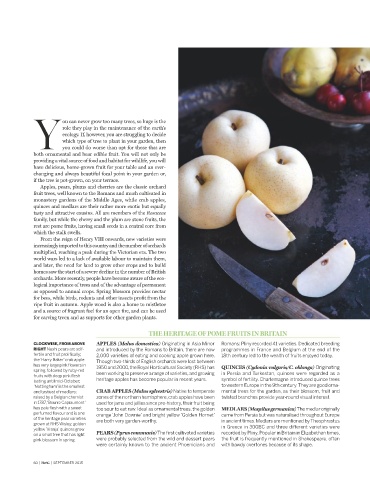
            CLOCKWISE, FROM ABOVE  APPLES (Malus domestica) Originating in Asia Minor  Romans: Pliny recorded 41 varieties. Dedicated breeding
            RIGHT Nashi pears are self-  and introduced by the Romans to Britain, there are now  programmes in France and Belgium at the end of the
            fertile and fruit prolifcally;   2,000 varieties of eating and cooking apple grown here.  18th century led to the wealth of fruits enjoyed today.
            the ‘Harry Baker’ crab apple  Though two-thirds of English orchards were lost between
            has very large pink fowers in  1950 and 2000, the Royal Horticultural Society (RHS) has  QUINCES (Cydonia vulgaris/C. oblonga) Originating
            spring, followed by ruby-red
            fruits with deep pink fesh  been working to preserve a range of varieties, and growing  in Persia and Turkestan,  quinces were regarded as a
            lasting until mid-October;   heritage apples has become popular in recent years.  symbol of fertility. Charlemagne introduced quince trees
            ‘Nottingham’ is the smallest                                    to western Europe in the 9th century. They are good orna-
            and tastiest of medlars;   CRAB APPLES (Malus sylvestris) Native to temperate  mental trees for the garden, as their blossom, fruit and
            raised by a Belgian chemist   zones of the northern hemisphere, crab apples have been  twisted branches provide year-round visual interest.
            in 1787, ‘Beurre Capiaumont’  used for jams and jellies since pre-history, their fruit being
            has pale fesh with a sweet  too sour to eat raw. Ideal as ornamental trees, the golden  MEDLARS (Mespilus germanica) The medlar originally
            perfumed favour and is one   orange ‘John Downie’ and bright yellow ‘Golden Hornet’  came from Persia but was naturalised throughout Europe
            of the heritage pear varieties  are both very garden-worthy.    in ancient times. Medlars are mentioned by Theophrastus
            grown at RHS Wisley; golden
            yellow ‘Vranja’ quinces grow                                    in Greece in 300BC and three different varieties were
            on a small tree that has light   PEARS (Pyrus communis) The frst cultivated varieties  recorded by Pliny. Popular in Britain in Elizabethan times,
            pink blossom in spring.   were probably selected from the wild and dessert pears  the fruit is frequently mentioned in Shakespeare, often
                                  were certainly known to the ancient Phoenicians and   with bawdy overtones because of its shape.


            60 | H&G | september 2015

