


Page 189 - Homes & Interiors Scotland
P. 189
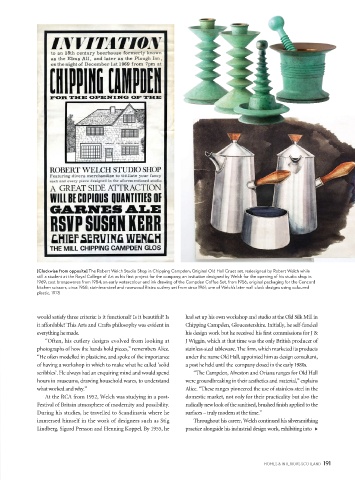
[Clockwise from opposite] The Robert Welch Studio Shop in Chipping Campden; Original Old Hall Cruet set, redesigned by Robert Welch while
              still a student at the Royal College of Art as his first project for the company; an invitation designed by Welch for the opening of his studio shop in
                  ; cast bronzewares from       an early watercolour and ink drawing of the Campden Coffee Set, from       original packaging for the Concord
              kitchen scissors, circa     ; stainless-steel and rosewood Bistro cutlery set from circa     ; one of Welch’s later wall clock designs using coloured
              plastic,


              would satisfy three criteria: is it functional? Is it beautiful? Is   had set up his own workshop and studio at the Old Silk Mill in
              it affordable? This Arts and Crafts philosophy was evident in   Chipping Campden, Gloucestershire. Initially, he self-funded
              everything he made.                                 his design work but he received his first commissions for J &
                 “Often, his cutlery designs evolved from looking at   J Wiggin, which at that time was the only British producer of
              photographs of how the hands hold pieces,” remembers Alice.   stainless-steel tableware. The firm, which marketed its products
              “He often modelled in plasticine, and spoke of the importance   under the name Old Hall, appointed him as design consultant,
              of having a workshop in which to make what he called ‘solid   a post he held until the  company closed in the early 1980s.
              scribbles’. He always had an enquiring mind and would spend   “The Campden, Alveston and Oriana ranges for Old Hall
              hours in museums, drawing household wares, to understand   were groundbreaking in their aesthetics and material,” explains
              what worked and why.”                               Alice. “These ranges pioneered the use of stainless steel in the
                 At the RCA from 1952, Welch was studying in a post-  domestic market, not only for their practicality but also the
              Festival of Britain atmosphere of modernity and possibility.   radically new look of the sanitised, brushed finish applied to the
              During his studies, he travelled to Scandinavia where he   surfaces – truly modern at the time.”
              immersed himself in the work of designers such as Stig   Throughout his career, Welch continued his silversmithing
              Lindberg, Sigurd Persson and Henning Koppel. By 1955, he   practice alongside his industrial design work, exhibiting into


                                                                                              HOMES & INTERIORS SCOTLAND

